
Professor Han Lamers
University of Oslo
The Norwegian Institute in Rome
Contested Words? Greek Learning
in Catholic Circles:
A Seventeenth‑Century Manuscript from Paris
Please register for the event here.
When:
Wednesday, Feb 25, 16:15-17:45
Where:
VUB Main Campus Etterbeek
Pleinlaan 2
1050 Elsene
Raadzaal C2.07a
*Free of charge*
The Vrije Universiteit Brussel and Professor Cornelis J. Schilt invite you to a lecture by Prof. Han Lamers (University of Oslo), entitled “Contested Words? Greek Learning in Catholic Circles — A Seventeenth‑Century Manuscript from Paris“. This lecture is part of the ERC lecture series ‘Knowledge in International Perspective’ (KIIP).
Contact: nicolo.cantoni@vub.be and demetrios.paraschos@vub.be
Prof. Han Lamers: Qui graecizabant, lutheranizabant — “Those who embraced Greek also embraced Luther.” These words, from the autobiography of the Jesuit Nicholas Bobadilla (d. 1590), are often cited to illustrate supposed Catholic hostility toward Greek learning. Although Greek studies in early modern Europe are frequently associated with the Reformation, their persistence and significance within the Catholic world remain understudied.
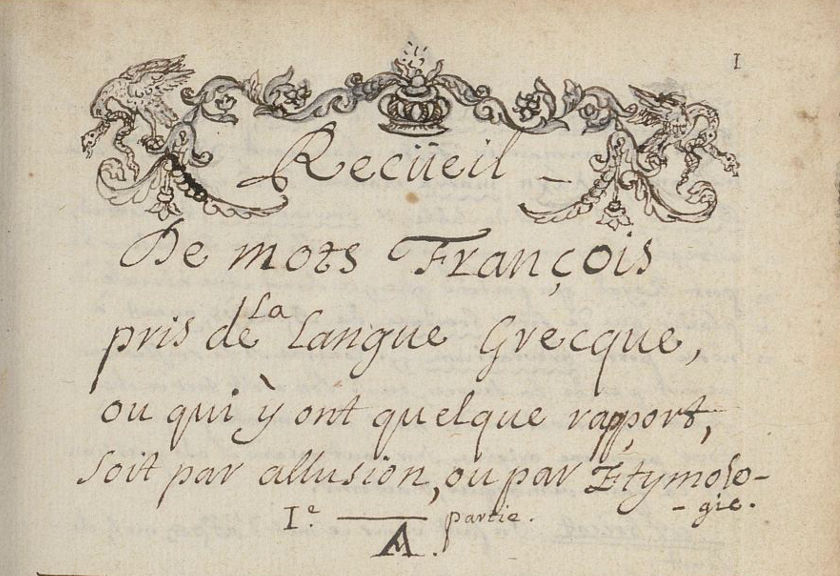
This lecture interrogates the role of Greek learning in Catholic circles and, more broadly, in early modern Europe, drawing on a recently rediscovered seventeenth‑century manuscript. The anonymous volume, now in the Bibliothèque de l’Arsenal (Paris), presents an extensive catalogue of French words paired with their purported ancient‑Greek equivalents, accompanied by short discussions of their meanings and connections. In the lecture I identify the manuscript’s author and reconstruct the project’s immediate Jansenist context. I also analyse the author’s scholarly method to show how he adopts and adapts a long‑standing tradition of French humanism dating back to the sixteenth century — primarily through the prism of Claude Lancelot’s Jardin des racines grecques and the Jansenist circle of Port‑Royal. What motivated the compilation of this word list? What was it intended to achieve, and for whom?
The author of this manuscript was neither the first nor the last to demonstrate affinities between his vernacular and ancient Greek; comparable examples appear in learned circles across Europe. Far from antiquarian curiosities, these word lists functioned as practical reading aids for classical and patristic texts, as miscellanies of useful information, as instruments for promoting the vernacular languages, and as subtle tools of cultural and confessional contestation — both between Catholics and Protestants and, in this instance, between Jansenists and Jesuits. As such, they show something of how Greek learning was variously adopted and contested in learned circles across early modern Europe.
About Professor Han Lamers
Han Lamers is Professor of Classics and Director of the Norwegian Institute in Rome. He studied Classics at Leiden University (BA, MPhil) and Art History at KU Leuven (BA, MA), and earned his PhD (2013) from Leiden University. His research focuses on the reception of ancient Greece and Rome, with particular attention to the cultural history and reinterpretation of ancient Greek and Latin in early modern and modern Europe. Before joining the University of Oslo in 2018 (Full Professor from 2019; Head of Subject 2020–2025), he held postdoctoral positions in Berlin, Ghent, and Leuven and received research fellowships from NWO, FWO, the Berlin Centre for the History of Knowledge (MPIWG), and the Volkswagen Foundation. He serves as Co-Editor of Symbolae Osloenses and sits on several editorial and advisory boards in the field of classical studies. A member of the Norwegian Non-Fiction Writers and Translators Association, he has taught widely in Classics, Renaissance literature and history, and the history of Classics and Art History, and is affiliated with the Heterodox Academy and the Heterodox Classics Community.
About Prof. Dr. Cornelis J. Schilt
Cornelis J. Schilt is a research professor in History and Philosophy of Knowledge at Vrije Universiteit Brussel, specialising in Renaissance, early modern knowledge formation in general and the life and writings of Isaac Newton in particular. In 2022, he received a prestigious ERC Starting Grant. With it, he started the project VERITRACE in which he investigates the influence of ancient wisdom writings on the development of early modern natural philosophy.